October 28, 2026 · Boston Squash
Squash Is Growing. Why Isn't It Booming?
Boston Squash · The Squash Shop · October 2026
Squash is growing, just not like pickleball and padel, which have become cultural moments in a few short years. Some of that comes down to the game itself: a four-walled squash court holds two players where a netted pickleball court holds four, and squash takes longer to learn and is harder to follow on screen.
This piece focuses on what can actually be changed, at both ends of the sport. At the top, that means how the Professional Squash Association (PSA) can restructure tournaments and borrow ideas from new formats like the National Squash League. At the grassroots, it means new systems like Graduate League Squash that give players a social reason to keep playing, and facilities like Maspeth Squash that turn a game of squash into a group event.
The growth gap
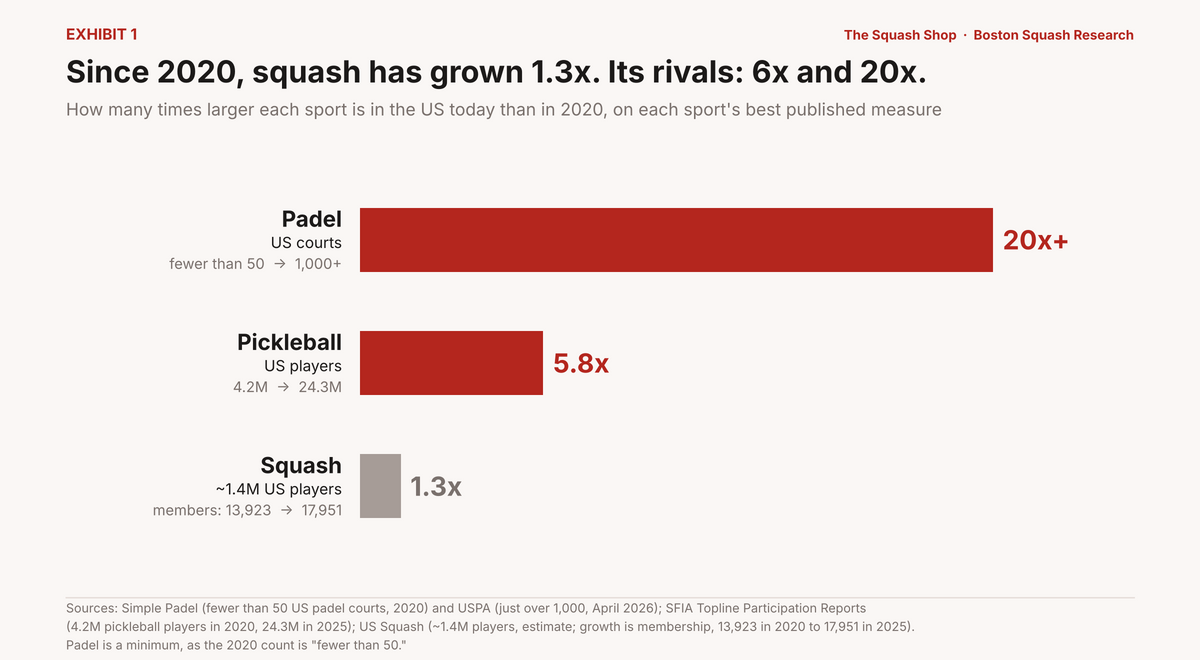
The numbers tell the story quickly:

Pickleball has now been the fastest-growing sport in America for five straight years. Padel only entered SFIA's survey in 2025 and is already past a million US players and climbing. Squash has an estimated 1.4 million US players, according to US Squash, and it's growing too, just far more slowly.
Why? Pickleball and padel are social, easy to learn and doubles-first, with community leagues and apps that make finding a game effortless. They are also sold as entertainment. Squash has work to do on both fronts: how the pro game is run and presented at the top, and how new players find a game and a group at the grassroots. We start at the top, with the PSA.
What the PSA gets right
Credit where it's due: the PSA has made real progress on the business of the pro game.
- Record prize money. $12.5 million in player compensation in 2024-25, up 18.4% in a year, with a target of $18 million by 2028.
- One tour for men and women. Equal prize money at the World Championships and a pay gap far narrower than in most pro sports.
- World-class venues. Glass courts in Grand Central Terminal, in front of the Pyramids and in central Paris.
- Its own media. SquashTV streams hundreds of matches a season, now including a free channel in the US.
- The Olympics. The PSA backed the World Squash Federation's long campaign to get squash into LA 2028, the biggest exposure opportunity the sport has ever had.
What the PSA gets wrong
Spend time on r/squash or in squash media and the same complaints keep coming up. Some are the PSA's to fix. Others are about how the whole sport is built. Note, these are not necessarily our opinions, but rather a reflection of the online narrative.
- The money stops at the top. A top-100 player averaged about $50,000 in 2025, before paying their own travel and coaching, per The Philadelphia Citizen. A tour that can't support its top 100 struggles to create stars.
- Officiating frustrates fans. Constant lets and disputed video reviews, with referees answering to the World Squash Federation rather than the PSA, make matches hard for newcomers to follow.
- It's hard to find. Core fans complain about falling viewership and decisions like holding back semi-final and final highlights from YouTube. Pickleball and padel grew on free, shareable clips, while squash's best moments often sit behind a subscription.
The innovation is coming from new leagues and facilities
While the tour debates incremental changes, the most interesting ideas in squash are coming from new leagues and facilities, at both the pro level and the grassroots.
The National Squash League (NSL)
The National Squash League is the first professional team squash league in the US. It was founded by pros Timmy Brownell and Spencer Lovejoy with Fernando Valdizan. It played its first season in 2024 with six teams, and now runs nine men's and six women's city-based franchises including the New York Knights, Nashville Crushers and the Philadelphia Lightning and Freedom. Lovejoy retired from the PSA tour in 2025 to become the league's CEO.
What makes it different:
- Team and city identity. Players are drafted onto city franchises and play for a local crowd, with home-court advantage.
- A clock. Matches are 3v3 and timed, about 70 minutes across three periods, with the first team to win two periods taking the match. Fans know when it starts and when it ends.
- Substitutions and power plays. Coaches can sub players in and out and deploy power plays at key moments, adding strategy fans already understand from hockey and basketball.
- Equal pay. Men and women are paid the same, scaled to their PSA ranking.
- Built to complement the tour. NSL events are scheduled around the PSA calendar so top players can do both. Lovejoy describes it as a supplemental product, not a rival.
It isn't profitable yet and has been largely owner-funded, and some traditionalists dislike the rule changes. But it is the most serious attempt yet to make pro squash feel like an American sports night out.
Graduate League Squash (GLS)
Graduate League Squash tackles a different leak in the pipeline: what happens after college. Founded by Aidan Ray (Dickinson '25) and Nieve Monderer (Tufts '25), GLS runs high-level tournaments for former college players who would otherwise put their rackets away after their last CSA nationals.
Its first Boston event at Summer Street Squash Club drew 35 players from more than 20 varsity and club programs, according to the College Squash Association. It has since run a 3v3 Boston event and a New York stop at Open Squash FiDi, with Baltimore next in December. GLS keeps men's and women's rankings and builds its identity around the hashtag #StayInIt. The model is simple: give post-grads a reason to keep training, a calendar, rivals and a community that travels city to city.
Facilities that make squash social
The biggest gap at the grassroots is a social on-ramp. Pickleball and padel are doubles-first: you show up, rotate in and meet people. Padel apps like Playtomic match strangers into games, and UK open matches doubled to about 90,000 a month during 2025. Squash is one-on-one, often behind private club doors, and many players drift away once their school or college team ends.
That's why the sport needs more places like Maspeth Squash. Built in the loading yard of a working steel fabrication shop in Queens and opened in 2021, its outdoor steel court has become a gathering spot for New York players, hosting pro-am and professional events where tour pros and local amateurs share the same court. It turns playing squash into something people show up for together. The sport needs more facilities built around community, not just court time.
Conclusion
The PSA has done the hard, unglamorous work of raising prize money, closing the gender gap, owning its broadcast and getting squash into the Olympics. What it hasn't done is make the sport easy to discover, easy to follow and fun to watch for someone who has never held a racket. Pickleball and padel have shown what community, accessibility and a reason to come back can do.
The NSL, GLS and venues like Maspeth Squash are proving squash can do the same. If the PSA leans into what these leagues and facilities are building rather than standing apart from it, squash has a real chance to turn LA 2028 into a growth curve, not a two-week spike.
Exhibit notes: Exhibit 1 uses each sport's best published US measure, so the three bars track different things. Padel is US courts, from fewer than 50 in 2020 (Simple Padel) to just over 1,000 in April 2026 (USPA); because the 2020 figure is a ceiling, 20x is a minimum. Pickleball is US players from the Sports & Fitness Industry Association (SFIA). Squash's 1.3x is US Squash membership, from 13,923 in 2020 to 17,951 in 2025; the roughly 1.4 million total US players is a US Squash estimate.
Sources
- SFIA: 2026 Pickleball Single Sport Report
- Club + Resort Business: Playtomic 2026 Global Padel Report
- The Padel Paper: UK padel participation rose 125% in 2025
- Squash Mad: PSA records prize money boost (2024-25)
- PSA: 2023-24 prize money
- Squash Mad: PSA eyes $18m prize money by 2028
- SVG Europe: SquashTV launches on Samsung TVs
- Sportcal: SquashTV launches FAST channel on Freevee
- Squash Mad: refereeing and the WSF
- The Philadelphia Citizen: Philadelphia Lightning and the NSL
- US Squash: Lovejoy retires from PSA tour to lead NSL
- The Squash Site: NSL 2026 season
- CSA: After graduation, the competition continues (GLS)
- Graduate League Squash
- Boston Squash Research: The Global Squash Industry (2026)
© 2026 Boston Squash LLC.