November 18, 2026 · Boston Squash
How to Pick the Best Squash Racket for Your Game (+ Racket Quiz)
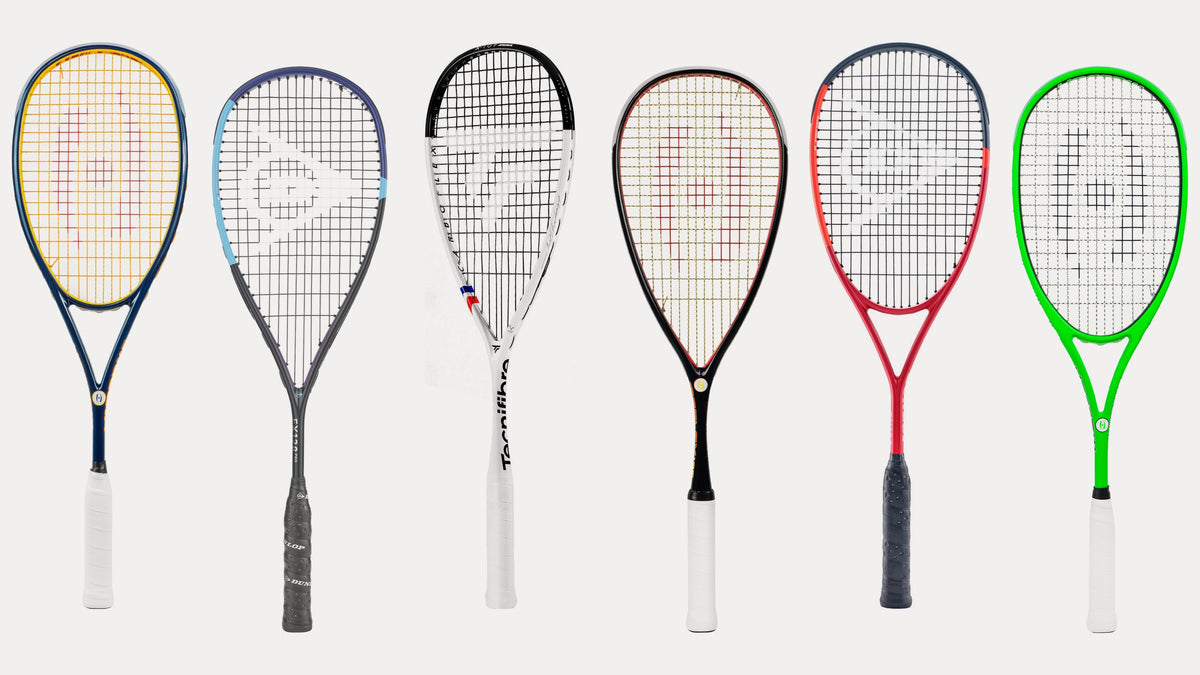
Walk into any pro shop and every squash racket on the wall promises "power and control." So how do you actually pick one? The good news: it comes down to a few simple ideas. Once you understand them, choosing the best squash racket for your game gets a lot easier.
This guide covers the big ones (head shape, weight and balance), how they line up with different kinds of players, and what to spend. In a hurry? The Racket Finder quiz above will match you to a racket in about a minute.
Start with one question: power or control?
Think about your last few matches. When a shot went wrong, what happened? If the ball kept landing short or sitting up in the middle of the court, you could use a racket that gives you more power. If it kept flying long, loose or out, you want one that gives you more control.
Almost everything about a racket's design pushes it one way or the other. Keep your answer in mind as you read on.
Open throat vs closed throat
Look at where the head of the racket meets the shaft. That's the single biggest difference between squash rackets.


Why does it matter? Strings work like a trampoline: the longer they are, the more they stretch and the harder they send the ball back. A closed throat (or "teardrop") racket has longer strings, so it gives you more free power and a bigger sweet spot. Off-center hits still travel. That makes it a great fit for newer players, players with a shorter swing, and anyone who feels they lack pace.
An open throat racket has a shorter, tighter string bed. The ball comes off a little slower but goes exactly where you aim it, and you feel more of it on the strings. Players who win with tight length, drops and touch at the front of the court often love an open throat.
Neither one is better. World champions have won with both. Go back to your answer above: need power, lean closed throat. Need control, lean open throat.
Weight and balance, in plain English
Most squash rackets have their weight in the name. The Vapor 115 weighs 115 grams before strings and grip, and around 140g ready to play.
Lighter rackets (110 to 120g) are fast and easy to whip around, which is great for volleys and quick exchanges. But they need a good, full swing to create pace, which is why they suit experienced players. Heavier rackets (130g and up) feel more solid and stable, and they help a shorter swing hit the ball deep. For most club players, somewhere around 120 to 125g is the sweet spot.
Balance tells you where that weight sits. A head-heavy racket puts more weight in the head, so it swings through the ball with more power. A head-light racket feels lighter than it is and reacts quickly at the front of the court. Even balance sits in between and suits most people.
One common mistake: buying the lightest racket you can find because the pros use them. Pros have the technique to make a feather-light frame work. If your swing is still developing, a few extra grams will actually make the ball go further.
Which racket suits your game?
Here's how that all adds up for the players we see most often.
If you're brand new, you want something forgiving and tough. Your first racket will hit the wall a lot, so don't spend $250 yet. A slightly heavier frame like the Harrow Storm 145 or the Dunlop FX130 does the work while you learn.
If you're coming from tennis or racquetball, you already have good hands but a longer swing than squash needs. A forgiving closed throat frame like the Harrow Response 120 or the Tecnifibre Carboflex Neo 125 lets you learn the shorter squash stroke without fighting the racket.
If you're an advanced player competing at the club, college or high school level and want the best tech available, we recommend the Tecnifibre Carboflex Neo 125. It's the newest generation of the Carboflex: light and fast at 125g, with a closed throat that adds easy power without giving up feel. If you have smaller hands, the Neo 125 NS has a slimmer handle.
If you like to hit hard from the back, a closed throat or head-heavy frame adds pace on every drive. The Harrow Reflex 125 and Dunlop FX 128 Pro are built for it.
If you win with touch and tight length, an open throat gives you the precision you rely on. The Harrow Vapor 115 is our go-to recommendation here.
If you attack early and volley everything, go light and quick. The Harrow Vapor 110 is one of the fastest-handling rackets we sell.
If your elbow or wrist gets sore, avoid very stiff, very light or head-heavy frames. Dunlop's 2026 FX 125 has built-in vibration damping, and dropping your string tension a couple of pounds helps too.
For kids, size matters more than anything. Ages 5 to 8 should use a short racket like the Dunlop Play Mini, ages 8 to 11 a 25-inch frame like the Tristorm JR 25, and most kids move to a full-size racket around 11 or 12.
Not sure where you fit? We recommend these:
Does the brand matter?
Less than you'd think. Every major brand makes excellent rackets, and each has a "house feel." Harrow is an American favorite in US clubs and college squash, known for crisp, lively frames and bold colors. Dunlop splits its range into FX rackets for power and CX rackets for control, which makes it easy to shop by style. Tecnifibre's Carboflex line is a tour favorite with a soft, connected feel, and its NS versions have a slimmer handle for smaller hands. Pick the racket that fits your game first and the brand second.
How much should you spend?
If you're just starting out, $70 to $100 gets you a durable racket that will see you through your first year. Once you're playing regularly, $150 to $180 is the best value in squash: real graphite performance without flagship pricing. Flagship rackets run $220 to $250 and are worth it once your technique can feel the difference. Every racket we sell comes strung and ready to play, with free shipping in the US.
Still not sure? Take the Racket Finder quiz
Answer a few quick questions about how you play and we'll match you to the racket that fits you best, with a link straight to it.
Quick answers
What is the best squash racket?
The one that fits your game. For most club players, a 115 to 125g racket is the right place to start: a closed throat like the Tecnifibre Carboflex Neo 125 or Harrow Response 120 for easy power, or an open throat like the Harrow Vapor 115 for control.
Is an open throat or closed throat squash racket better?
Neither is better overall. Closed throat (teardrop) rackets have longer strings, so they give more power and a bigger sweet spot. Open throat rackets give more control and feel.
What weight squash racket should a beginner use?
A slightly heavier, forgiving racket, around 140g or more, or a durable aluminium frame. Very light rackets need good technique to generate power.
Do squash rackets come strung?
Yes. Every racket we sell comes strung and ready to play.
Ready to find yours?
Browse all squash rackets, or ask us and we'll help you choose.
Take the quiz Shop all rackets